Key takeaways:
A chemical peel uses acids to lift away damaged surface cells and prompt renewal underneath — clearer skin, brighter tone, softer texture and, over a course, more collagen. The change most of my clients actually talk about isn't in the mirror on the day. It's the getting-ready time they get back, and how optional makeup starts to feel.
Everyone thinks chemical peels are about resurfacing. Technically, they are — but that's the mechanism, not the point. The clients who come back to me for a second and third peel almost never lead with "my texture has improved." They say something much more ordinary and much more telling: I'm ready quicker in the mornings. My makeup sits properly now. Some days I don't bother with it at all.
That's the benefit worth writing about, so this article covers both — what a peel does to your skin, and what clearer skin does to your week.
What a chemical peel actually does
Peels aren't a modern fad; they're one of the most established treatments in dermatology. As the clinical reference StatPearls sets out, chemical peels are used for acne vulgaris, melasma, wrinkles, photodamage, photoageing, pigmentation disorders and acne scarring — therapeutic as well as cosmetic. A tailored acid solution is applied for a controlled period, loosening the bonds between tired surface cells so they shed and are replaced by newer skin beneath.
The second half is the part people miss. That controlled renewal also signals repair in the deeper layers: peels address sun damage and photoageing by removing damaged surface cells while stimulating collagen production. Glycolic acid in particular has been shown to stimulate fibroblast proliferation and induce collagen synthesis while reducing collagen breakdown — the same regenerative logic behind the skin boosters and polynucleotides that dominate 2026, applied from the outside in.
Not all peels are the same — and that's the whole skill
"Chemical peel" describes a category, not a product. Choosing within it is where the clinical judgement lives:
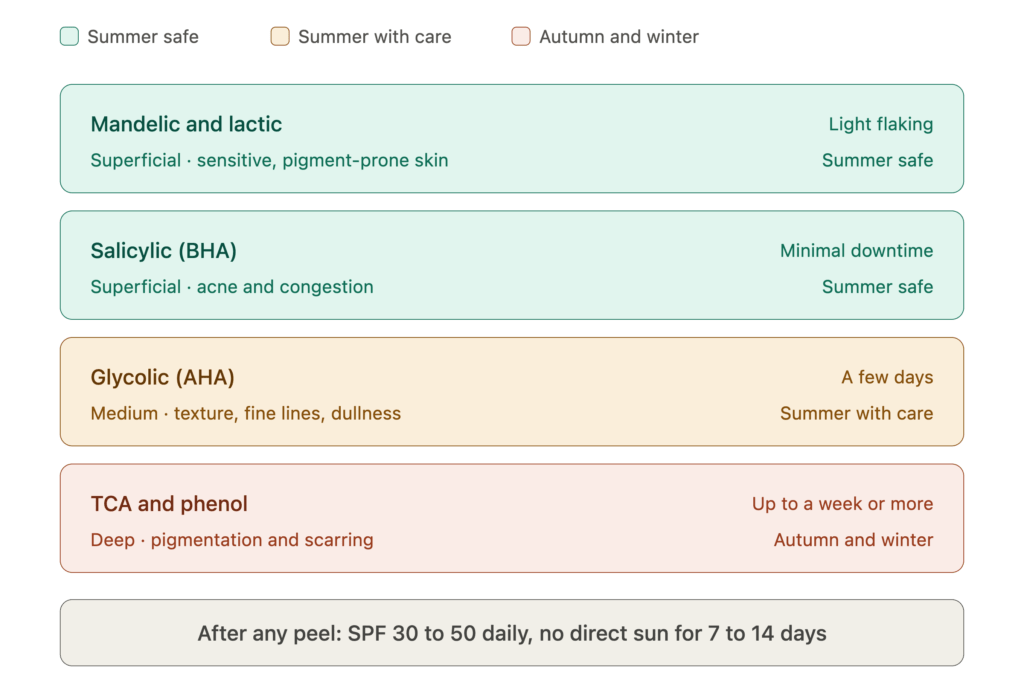
- Salicylic acid (BHA) is oil-soluble, so it travels into the pore itself — the natural choice for active acne, blackheads and oily, congested skin, dissolving the sebum and debris that fuel breakouts.
- Glycolic acid (AHA) is the smallest AHA molecule and penetrates efficiently, making it the workhorse for overall texture, fine lines and dullness.
- Mandelic and lactic acids are gentler and slower-penetrating — my preference for sensitive skin, for deeper skin tones where pigment risk needs respecting, and for summer.
- Medium and deep peels (TCA, phenol) go further and deliver more, but with real downtime and, in the deepest cases, medical supervision and substantial risk. They are autumn-and-winter treatments, and not something to buy on price.
Depth is the trade-off you're really choosing between: superficial peels cause minimal downtime with perhaps light flaking for a few days, while medium peels can involve more noticeable peeling and redness lasting up to a week. That's why I won't sell you a peel off a menu. Skin type, pigment tendency, current skincare, recent sun exposure and what your next fortnight looks like all change the answer.
Can you have a peel in summer?
Yes — with the right peel and non-negotiable aftercare. Freshly peeled skin has lost some of its protective surface layer, which temporarily raises the risk of burning and, most importantly, of post-inflammatory hyperpigmentation — ironically darkening the very marks you came to treat. So in July my rule is: superficial only, and sun protection treated as part of the treatment rather than a suggestion. Standard guidance is to avoid direct sun for at least 7–10 days after a peel, using SPF 30 or higher and reapplying every two hours, and to arrive with skin that isn't freshly tanned.
This is the same logic I apply to every summer treatment — the detail is in my summer aftercare guide, and if you're travelling, book your peel before the countdown in my holiday treatment timeline runs out. A peel in the week before a beach holiday is one of the few treatments I'll flatly refuse.
The benefit nobody advertises: your mornings
Here's what a 30-minute appointment quietly buys you. When skin is clearer and smoother, foundation stops clinging to flaky patches and settling into texture. Concealer has less to do. The routine shortens — and, for a lot of my clients, some days it disappears entirely.
That matters more than it sounds. A 2026 report by Liz Earle Beauty Co., which polled 5,000 women, found 66% said their complexion had previously affected their personal relationships, 19% had skipped social gatherings because of a bad skin day and 22% had avoided going out altogether. The same research found three quarters of women now feel comfortable leaving the house make-up free, and 63% said a good skin day can transform their mood for the day ahead.
That's the shift I see in the chair. Not a dramatic transformation — a quiet reduction in how much of your attention your skin demands. Fewer minutes at the mirror, fewer decisions, less pressure to cover up before you answer the door. Treating the skin rather than decorating it is also, incidentally, exactly where aesthetics as a whole has moved: the natural-look shift is the same instinct at a different scale.
What to expect, honestly
A superficial peel appointment runs around half an hour. Expect warmth or tingling during application, some redness afterwards, and light flaking for a few days — not the dramatic sheeting people picture from films. Results are cumulative: one peel brightens, a course spaced two to four weeks apart is what changes congestion, tone and texture. Peels also combine well with other treatments — pairing surface work with the deeper collagen stimulation of microneedling is one of the genuine trends of 2026 — but sequencing matters, and stacking treatments too close together is how skin barriers get damaged.
Peels aren't for everyone. Active eczema or rosacea flares, certain medications (including recent roaccutane), pregnancy and breastfeeding, recent sun exposure or a fresh tan, and a history of keloid scarring can all mean "not now" or "not this one". Deeper skin tones need a practitioner who understands pigment risk and chooses conservatively — treating summer peels as a one-size-fits-all decision is exactly where clients with melanin-rich skin get let down. If you're weighing up who to trust with any of this, my checklist for choosing a safe aesthetics practitioner applies here just as much as it does to injectables.
FAQ
What are the benefits of a chemical peel?
Clearer skin with fewer breakouts, brighter and more even tone, softened fine lines, refined texture and, over a course, increased collagen. Day to day: makeup applies better, and needing it becomes optional.
Can you have a chemical peel in summer?
Yes, with a superficial peel and strict sun protection. Medium and deep peels are better booked for autumn and winter.
How long does a chemical peel take?
Around 30 minutes for a superficial peel, with light flaking for a few days afterwards.
How many chemical peels do you need?
Most skin responds best to a course spaced two to four weeks apart, then occasional maintenance.
Book a skin consultation at my Loughborough clinic, or in Leicester, Nottingham, Derby, Birmingham and Bristol — bring your skin, your diary and your holiday dates, and I'll tell you honestly whether a peel is the right next step or whether something gentler will get you there.
Chemical peels carry risks including redness, irritation, prolonged peeling, infection and post-inflammatory hyperpigmentation; suitability, peel type and strength are assessed at consultation. Treatments are for adults aged 18+. Sources: StatPearls, Chemical Peels for Skin Resurfacing (NCBI); Glycolic acid and collagen synthesis, NCBI; Chemical Peels in the UK, Salon Searcher; Key chemical peel benefits 2026; Liz Earle Beauty Co. / OnePoll skin confidence report, 2026.